How to Solve Triangle Problems: Steps, Checks, and Common Mistakes
Learn how to solve triangle problems with clear steps, self-checks, and common pitfalls to avoid. Practical methods you can use on homework or tests.
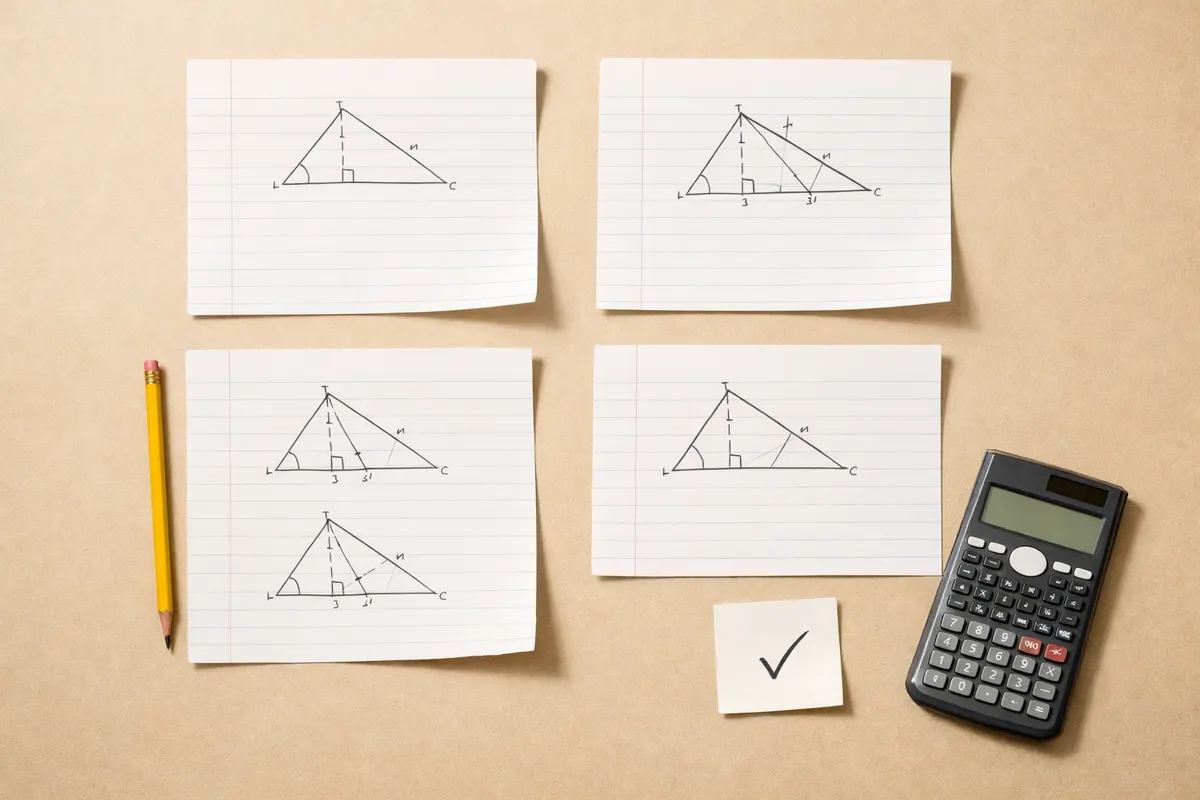
Quick answer: how to solve triangle problems
How to solve triangle problems starts with three actions: read carefully, draw a clear diagram, and mark exactly what the problem gives. Most triangle problems ask for a missing side, angle, area, or to prove a relationship; the same checklist narrows your approach quickly.
If you see a right angle or three side lengths, use Pythagoras or direct distance formulas. If you have two angles and a side, use basic trigonometry or the law of sines. When sides and an included angle appear, the law of cosines is usually the correct choice.
Always perform a quick sanity check: does the answer have the right magnitude (a long side shouldn’t be smaller than the others), do the angles sum to 180°, and does any computed side obey triangle inequality? Those checks catch most algebra slips before you finalize your solution.
- Identify given items: sides, angles, parallel lines, right-angle marks.
- Pick the simplest applicable method: Pythagoras, trig, law of sines/cosines, or coordinate geometry.
- Verify with at least one independent check: back-substitute, estimate, or re-solve using a different method.
What solving triangle problems actually asks you to do
Solving triangle problems means translating a geometric description into a chain of explicit relationships you can manipulate algebraically. That translation step — turning words and diagram labels into equations — is the most common source of error. For example, the phrase “the hypotenuse is 5 cm longer than a leg” must become a variable equation, not an ad-hoc numeric swap.
Triangles are defined by three sides and three angles, but problems often give only part of those six values. The key is to identify which rules connect the given pieces: the angle-sum rule (angles add to 180°), similarity ratios, congruence criteria (SSS, SAS, ASA), Pythagoras for right triangles, and trigonometric relations (sine, cosine, tangent) and the laws of sines and cosines for general cases.
Some problems are purely numeric (compute a missing length), some are proof-based (show two triangles are congruent), and some are application problems (find area, optimize a dimension). Knowing the problem type narrows the toolbox: proofs need clear reasons for each step; computations need consistent units and error checks.
- Computation tasks: solve for lengths, angles, or area using formulas.
- Proof tasks: establish congruence or similarity with labeled reasons.
- Application tasks: translate a real-world constraint into a geometric statement.
Key clues
A careful read of the diagram and text yields the strongest clues for choosing a method. Look for explicit angle markings (arc ticks or right-angle squares), tick marks on sides indicating equality, numeric labels with units, and labels of parallel lines or transversals that imply angle relationships.
Contextual clues in the wording matter: phrases like “included angle” point to the law of cosines; “opposite an acute angle” suggests standard trig; “similar triangles” or proportional phrasing indicates you should set up ratios rather than trig or Pythagoras. Coordinates or a grid point toward coordinate geometry techniques.
Always check for hidden or implied information: a diagram without scale might still include congruence marks; a side labeled as adjacent in a trig context gives which ratio to use. These clues guide the first method you try and reduce wasted algebra.
- Right-angle box = Pythagoras or trig on legs and hypotenuse.
- Tick marks on sides = equal lengths; use congruence or isosceles properties.
- An ‘included angle’ wording = consider law of cosines for side computations.
- Coordinates or vertex labels = distance formula and slope checks.
- If text implies proportional segments or parallel lines, try similarity ratios.
Step-by-step workflow for solving triangle problems
1) Read and redraw: Copy the diagram by hand, label knowns and unknowns, and add variable names to unknown sides or angles. A clean sketch reduces transcription mistakes that lead to wrong equations.
2) Classify the triangle and goal: Is it right, isosceles, equilateral, or scalene? Are you solving for a side, an angle, area, or proving congruence/similarity? This classification immediately filters the candidate methods.
3) Choose the simplest method that uses the fewest unknowns. Typical choices: Pythagorean theorem when you have a right triangle; trigonometric ratios (sin, cos, tan) when you have an angle and a side; the law of sines with an angle-side opposite pair; the law of cosines when two sides and included angle are known; coordinate methods when vertex coordinates are given.
4) Write equations carefully and solve algebraically. Keep track of units, isolate the unknown, and maintain exact forms until a final numeric rounding. When solving a quadratic, check both roots for geometric validity (positive lengths, angles between 0° and 180°).
5) Verify with at least two checks: back-substitute values into the original equations, confirm angle sum equals 180°, test triangle inequality (a + b > c for any side ordering), and, if possible, compute the same quantity with an alternate method to ensure consistency.
- Label variables: name unknown sides as a, b, c and angles as A, B, C consistently.
- Translate words to equations before plugging in numbers.
- Keep exact values when possible; round only at the final step.
- When using trig, be careful with calculator mode (degrees vs radians).
- If you get an impossible value (negative side, angle >180°), re-check algebra and diagram interpretation.
Worked examples: common triangle problem types
Example 1 — Right triangle, missing side: Suppose triangle ABC is right at C, with AC = 6 and BC = 8, find AB. Label AB = c. Use Pythagoras: c^2 = AC^2 + BC^2 = 36 + 64 = 100, so c = 10. Quick checks: the computed hypotenuse 10 is longer than both legs, and the Pythagorean triple 6-8-10 is a familiar sanity check.
Example 2 — Law of cosines for an included angle: Given sides a = 7, b = 9, and included angle C = 60°, find side c. Use law of cosines: c^2 = a^2 + b^2 - 2ab cos C = 49 + 81 - 126*cos 60° = 130 - 126*(0.5) = 130 - 63 = 67. So c = sqrt(67). Verification steps: check that the angle value and side lengths are consistent via the law of sines if an angle opposite a known side is available, or verify numeric plausibility (sqrt(67) ≈ 8.19, between 7 and 9).
Example 3 — Law of sines with ambiguous case: Suppose angle A = 30°, side a = 8, and side b = 13. Use law of sines to find sin B = b*sin A / a = 13*sin30°/8 = 13*0.5/8 = 6.5/8 = 0.8125. That gives angle B ≈ arcsin(0.8125) ≈ 54.0°. But because sin(180° − x) = sin x, an alternate B' = 126.0° is possible; check whether B' + A < 180° to see if that second solution is valid. This is the classic SSA ambiguity — verify by testing both possibilities against the rest of the problem.
Example 4 — Coordinates and distances: Triangle with vertices at (1,2), (5,2), and (5,6). Compute side lengths using the distance formula: between (1,2) and (5,2) is 4, between (5,2) and (5,6) is 4, and between (1,2) and (5,6) is sqrt((4)^2+(4)^2)=sqrt(32)=~5.657. The two equal legs indicate an isosceles triangle; check angle measures with slopes or vector dot products if needed.
- For right triangles: prefer Pythagoras or trig on legs/hypotenuse.
- For known included angles: law of cosines yields direct side computations.
- For SSA: always check for two possible angle solutions and confirm validity.
- For coordinates: distance and dot-product checks make numerical validation straightforward.
Limitations
Diagrams in problem statements are often not to scale. A sketch that looks acute might actually be obtuse per the numeric givens; never infer exact values from appearance alone. Always trust labeled measures and algebraic consequences over eyeballing lengths or angles.
Measurement precision and rounding can alter plausibility checks. If given sides are measured (for example from a photograph) they may include error; report answers with appropriate sig figs and note uncertainty when using approximate data. Problems that originate from photos or scans may hide small angles or near-collinear points that change which solution is valid.
Some problem types carry inherent ambiguity or multiple valid solutions (SSA ambiguous case, or problems that allow congruent triangles). When you encounter multiple mathematical possibilities, enumerate each, justify why one is chosen (e.g., by context or additional constraints), or state all valid solutions explicitly.
- Do not assume diagrams are to scale; rely on given numbers and derived equations.
- When data comes from measurement (photo, scan), treat lengths as approximate and include rounding rationale.
- Ambiguous setups (SSA) require checking both mathematical possibilities and discarding invalid ones.
- If a computed result contradicts geometry basics (negative length, angle outside 0–180°), stop and re-check assumptions.
Related guides
Use Geometry AI to check your triangle solution steps
After you work through the steps and run the checks here, use Geometry AI as an optional next step to verify calculations and catch slips. The triangle calculator at https://geometryai.app/tools/triangle-calculator checks numeric work and shows the same formulas used above so you can compare steps side by side. Treat any automated result as a verification aid — not a substitute for understanding — and re-run the manual checks if the app highlights inconsistencies.

Frequently asked questions
Where can I find triangle help when I'm stuck on a homework problem?
Start by reworking the diagram and labeling every known quantity; then try the simplest method listed in this guide. If you still need help, gather the problem text and a clear diagram and ask a teacher, tutor, or a study forum (show your steps, not just the final answer). You can also use tools like the Geometry AI triangle calculator to check computations as a second opinion, but treat any automated check as a verification step rather than a substitute for understanding.
How do I check my triangle solution for arithmetic or reasoning mistakes?
Run at least two independent checks: back-substitute your numeric answer into the original equations, confirm that all three angles sum to 180°, and verify the triangle inequality for side lengths. If you used trigonometry, recompute an angle with an alternate identity (for example, use arctan from two sides if you used arcsin initially). Also perform an order-of-magnitude estimate: compare computed lengths to the sketch to ensure they’re in the expected range.
What are the most common mistakes students make on triangle problems?
Common errors include misreading which angle is opposite which side, using the wrong trigonometric ratio, forgetting to convert degrees/radians, mishandling algebra (losing a negative sign), and rounding too early. Other frequent mistakes are assuming a diagram is to scale and failing to test both roots of a quadratic or both angles in an SSA ambiguous case. Tackling these systematically — label carefully, keep exact values until the end, and run the verification checklist — prevents most errors.
When does SSA create two possible triangle solutions and how should I handle it?
The SSA (side-side-angle) configuration can be ambiguous when you know two sides and an angle that is not included between them. Using the law of sines may produce sin B = value with two possible angles (B and 180°−B). To handle SSA, compute both angle possibilities and test whether each leads to a valid triangle where the sum of angles is less than 180°. If both are valid, present both solutions; if one leads to contradiction (angles sum > 180° or negative side), discard it and justify why.