Geometry HTML: Worked Steps, Common Mistakes, and How to Check Answers
A practical guide to geometry html: how to read diagrams, verify each step, and use a checklist to avoid common mistakes before using an app to double-check.
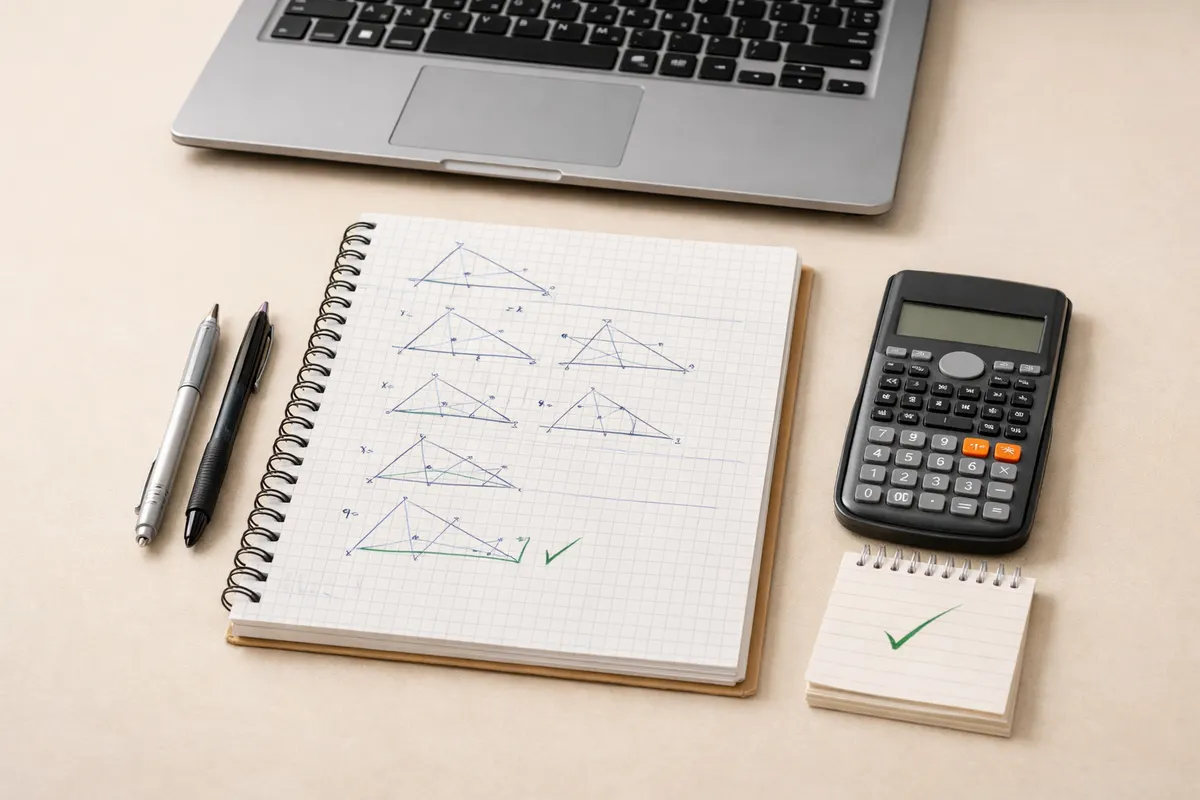
Quick answer: what geometry html users need first
Geometry html searches often aim to find or verify worked steps for a geometry problem shown in an image, screenshot, or text rendered on a page. The fastest reliable approach is methodical: extract the givens, redraw or re-label the diagram at scale, run the algebra or angle-chasing step-by-step, and then apply a short verification checklist to catch common errors.
Start by writing down the explicit givens and what the problem asks for. Many mistakes come from misreading a single symbol (a dash for congruence, a small mark for parallel lines, or a mis-copied numerical value). If you confirm the givens first, you reduce the chance of building a solution from the wrong assumptions.
After you complete the solution, check units, substitute your answer back into intermediate equations when possible, and verify with a second method (for example, use coordinate placement for a synthetic proof). This stepwise verification is what separates a plausible answer from a reliable one.
What geometry html means in practice
When someone searches for geometry html they usually want an interpretation of a geometry problem that appears on a webpage or as an image embedded in HTML. That includes understanding labeled diagrams, interpreting shorthand notation (arcs, marks, and angle symbols), and converting visual givens into algebraic or geometric statements that you can work with.
In practice this means translating the visual layout into a clear set of steps: identify known side lengths or angles, note parallel or perpendicular markings, list congruences, and decide whether coordinate, vector, synthetic, or trigonometric techniques are the most direct path. Treat the HTML image or diagram as a source of clues, not as the final authority—annotations or compression artifacts can hide details.
The goal isn’t just to produce an answer but to show the reasoning. A worked solution that hides steps makes it hard to spot a single slip. Good geometry html results present a short chain of clearly labeled steps that another reader can follow, re-run, and test with a different method if needed.
Geometry help: key visual and textual clues to check
A quick visual scan for the strongest clues saves time. First look for explicit marks: tick marks on sides indicate equality, slashes on angles can indicate congruence, and small square boxes denote a right angle. Those little marks change the whole approach—treat them as givens unless the problem text contradicts them.
Next check labels and units. Are points labeled consistently (A, B, C) or are there duplicate labels? Does the figure show lengths or only relative measures? If numeric values appear, confirm whether they are exact (5, √2) or approximate (5.0, 3.14). Small differences in formatting often signal rounding that affects the final numeric answer.
Finally, inspect the context in the HTML: captions, preceding sentences, or adjacent equations often contain crucial constraints—'AB ∥ CD', 'circle center O', or 'diagram not to scale' change what methods are valid. If the problem says the figure is not to scale, rely on symbolic relationships rather than trusting angles you visually estimate from the picture.
- Tick marks and dashed lines: equality and parallel/perpendicular indicators
- Angle notation: small arc marks, labeled angle names, and right-angle squares
- Numeric format: exact vs approximate values and implied units
- Context text: captions or problem statements that add hidden givens
- Scale notes: explicitly not-to-scale diagrams force algebraic checks
Step-by-step workflow
1) Read and record the givens. Copy every symbol and numeric value you see into a short list: given sides, angles, parallel lines, congruent segments, midpoints, centers, and any algebraic relationships. If a diagram has labels that could be confused (for example O and 0), rewrite them clearly and consistently.
2) Redraw and annotate. Even a rough hand sketch with the same labels helps you reason visually. Add marks you confirmed from the source (tick marks, right-angle boxes) and write numerical labels clearly. If the problem can be placed on a coordinate grid, choose coordinates that simplify the algebra—put a vertex at the origin or align a side with the x-axis.
3) Pick a method and outline the plan. Decide whether synthetic geometry (angle-chasing), coordinate geometry, trigonometry, or similarity will be cleanest. Write a two-line plan: e.g., 'Use similarity between triangles A B C and A D E to solve for x, then apply the Law of Cosines for side length.'
4) Execute steps with brief justification. For each inference write the justification next to it: 'angles equal because lines are parallel', 'SSS implies triangles congruent', or 'use Pythagorean theorem.' Keep algebra tidy—hide fewer steps rather than more. When you manipulate an equation, label substitutions explicitly so you can backtrack.
5) Verify as you go. After a key step, pause and substitute your intermediate result into a different relation from the list of givens. For numeric answers, check them with arithmetic reversed (plug lengths into the Pythagorean relation or recompute a triangle area from two methods). For proofs, see if the same conclusion follows from a separate lemma you can derive from the diagram.
- Write every explicit given before solving
- Redraw and re-label the diagram for clarity
- Choose the simplest coordinate placement when useful
- Attach a short justification to each inference
- Do a quick substitution check after major steps
Examples: worked checks for common geometry html cases
Example 1 — Triangle with marked equal sides. Problem: an isosceles triangle ABC has AB = AC and angle B = 50°. Find angle C. Worked steps: record AB = AC, so base angles B and C are equal; therefore angle C = 50°. Quick checks: confirm tick marks on AB and AC, confirm no other angle marks contradicting base-angle equality, and substitute to check that angles sum to 180°.
Example 2 — Circle tangent and chord. Problem: A line tangent to a circle at T forms a 40° angle with chord TA. Find the inscribed angle subtended by the arc. Worked steps: use tangent–chord theorem: the angle between tangent and chord equals the angle in the opposite arc. So the inscribed angle on that arc is 40°. Quick checks: confirm the figure labels the line as tangent (often a little perpendicular mark to radius OT) and verify the point T is on the circle; if the diagram looks off-scale, rely on the theorem rather than eyeballing the angle.
Example 3 — Coordinate placement for algebraic unknowns. Problem: Given triangle with vertices A(0,0), B(b,0), C(0,c) and right angle at A, find the area when b and c are given algebraically. Worked steps: place A at origin and align AB with x-axis to get coordinates directly; area = (1/2)*b*c. Quick checks: plug a numeric pair (b=4, c=3) to ensure the formula yields 6 and confirm with a drawn sketch if necessary.
Each example shows the same pattern: identify the core theorem or trick, make a minimal but explicit drawing or coordinate choice, and run a short verification: substitute a numeric test or check an independent relation that must hold.
- Isosceles triangle: confirm tick marks then use base-angle equality
- Tangent–chord: verify tangent mark or perpendicular radius clue
- Coordinate trick: place vertices to reduce algebraic overhead
- Numerical sanity check: substitute easy numbers to confirm formulas
Limitations: when a worked geometry html answer is unreliable
Visual evidence can be misleading. Compressed or low-resolution images hide tick marks and small labels; screenshots cropped from textbook PDFs can remove nearby explanatory text. If a diagram lacks explicit markings or the problem statement says 'not to scale', do not rely on measurements taken directly from the image.
Algebra and arithmetic errors are common in intermediate steps. Even a correct plan can yield a wrong numeric answer because of a sign mistake, dropped term, or rounding. That is why substitution and independent re-checks are essential. If your numeric answer depends on a decimal approximation, state the rounding and check whether a symbolic simplification is possible.
There are cases where a diagram supports multiple interpretations (ambiguous labeling, overlapping points, or omitted constraints). When ambiguity exists, list the alternate valid interpretations and solve each case or explicitly state the assumption you are using. If an interpretation changes the final result, treat the answer as conditional pending clarification.
When to seek outside help: if the diagram is unclear, a small mark affects the deduction, or the stakes are high (graded exam, published solution), verify with a teacher, peer, or a trusted geometry tutor rather than relying solely on app suggestions. Use app tools as a first-pass check, not as a definitive professional verification.
- Low-resolution images can hide crucial marks
- Rounding and algebra slips often cause numeric errors
- Ambiguous diagrams require listing alternate interpretations
- Consult a teacher or tutor for high-stakes answers
Related guides
Use Geometry AI to check your steps, not replace them
After you run the verification checklist, use the Geometry AI iOS app to scan or photograph your handwritten steps and get a second-pass check for algebra slips and missing justifications. Treat the app as a fast reviewer: it helps find likely arithmetic or labeling mistakes, but always use your own step-by-step checks before accepting a final answer.

Frequently asked questions
How to solve geometry problems step-by-step when I'm stuck on a triangle?
Start by listing the givens and redraw the triangle with clear labels. Choose a method: angle-chasing, similarity, or coordinates. If angle-chasing, mark equal angles and write the chain of equalities; if similarity, identify corresponding sides and set up proportions; if coordinates, place one vertex at the origin and align a convenient side with an axis. After finding a result, substitute numeric values back into an independent relation (for example, check side lengths with Pythagoras) to confirm. If multiple methods apply, run a second method as a cross-check.
What quick checks should I run to be confident in a geometry html solution?
Run three quick checks: (1) verify givens and diagram marks match the solution’s assumptions, (2) substitute intermediate numerical results into a different equation from the problem, and (3) perform a sanity check using an alternate method (coordinate placement, numeric test, or symmetry argument). Also inspect units and round-off: if a value looks odd, try simple integer test values to see if the relationship holds.
How accurate are answers when I only have a photo of a diagram and need geometry help?
Photos can be accurate for structural clues (labels, tick marks, right-angle boxes), but small or faint marks can be missed and scale may be misleading. Use the photo to extract explicit givens and context text, then treat measurements from the image as approximate. For reliable conclusions, convert the visual info into symbolic constraints and verify results algebraically or with a coordinate model rather than relying on measured pixel angles.
When should I stop checking and trust a solved geometry html answer?
Trust grows with independent confirmations: if two different methods yield the same result, if numerical substitution passes sanity checks, and if all givens from the diagram and text are consistent with the solution, it’s reasonable to accept the answer. Stop and get more evidence when a single tiny diagram mark would change the result, when the arithmetic is messy and unchecked, or when the answer will be used in a high-stakes setting—those cases deserve an external verification from a teacher or trusted tutor.